Upload a Clear Front-Facing Photo
Choose a photo where your forehead, cheekbones, and jawline are visible. A neutral expression, even lighting, and minimal hair covering your face help the face shape detector read your proportions more accurately.
Upload a clear photo and use our AI face shape detector to find your face shape online. Discover whether your face is oval, round, square, heart, diamond, oblong, or triangle, and learn why that face shape matches your proportions.
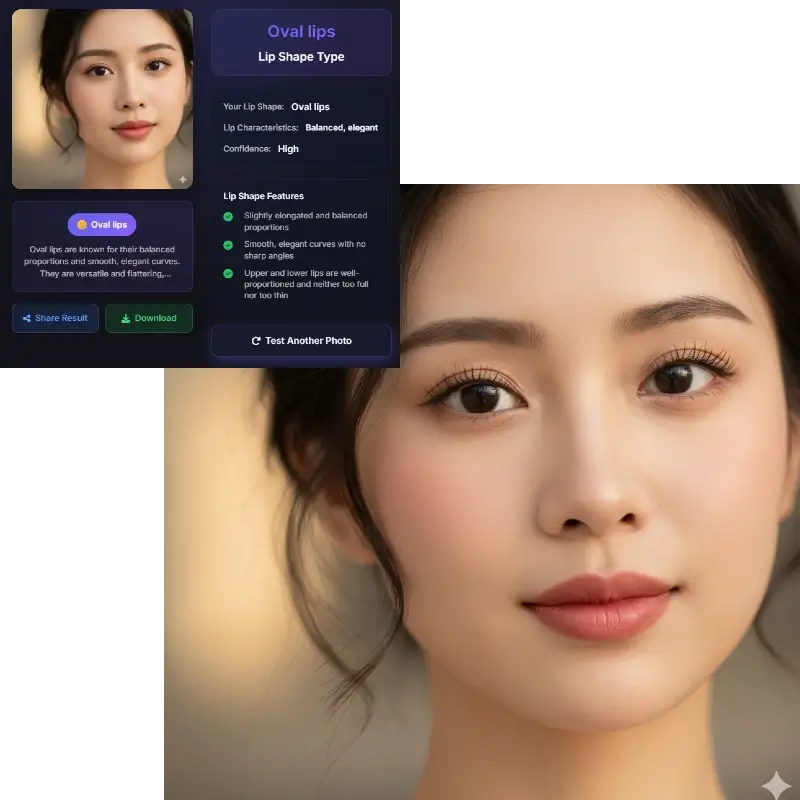

Use a front-facing photo with your hair away from your forehead and jawline, or drag, drop, or paste an image.
Choose a photo where your forehead, cheekbones, and jawline are visible. A neutral expression, even lighting, and minimal hair covering your face help the face shape detector read your proportions more accurately.
The face shape detector looks at visible facial landmarks and compares face length, forehead width, cheekbone width, jaw width, and the way your features taper from top to bottom.
You will get a primary face shape match, a confidence level, and practical notes that explain why your face looks closest to an oval, round, square, heart, diamond, oblong, or triangle face shape.
Most face shape detector tools group faces into a few broad categories. These descriptions help you understand what each result means and why two similar-looking face shapes can still be different.
An oval face shape is usually longer than it is wide, with softly curved sides and balanced proportions. The forehead is often slightly wider than the jaw, while the cheekbones sit as the widest point. Many people search for an oval face shape because it works well with a wide range of hairstyles, glasses, and makeup styles.
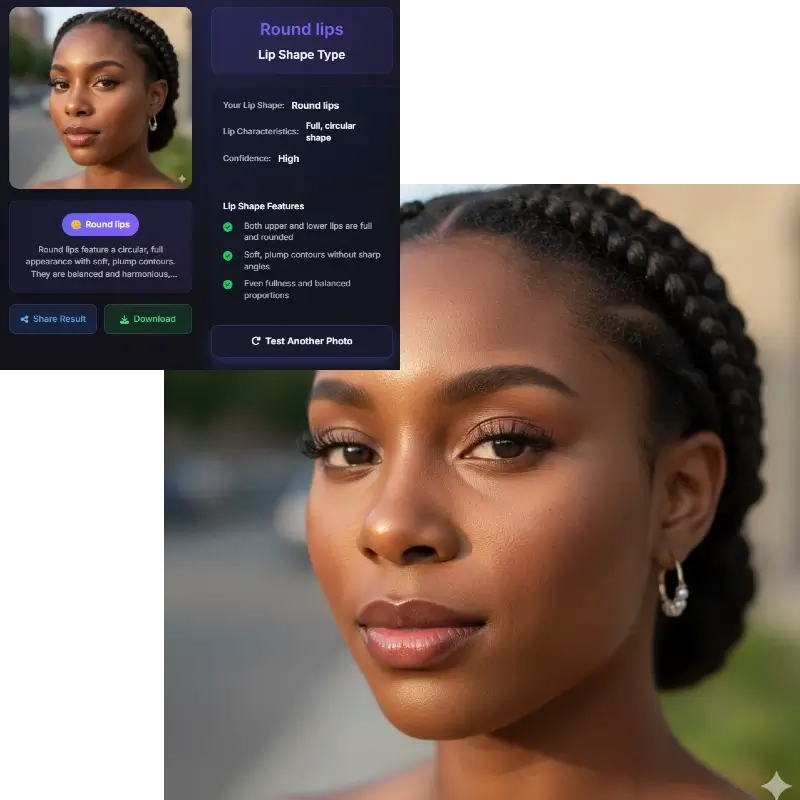
A round face shape has softer angles and a face length that is close to the width. The cheeks can appear fuller, and the jawline tends to feel smooth rather than sharply defined. If a face shape detector identifies a round face, it usually means the overall outline looks balanced and curved instead of long or angular.
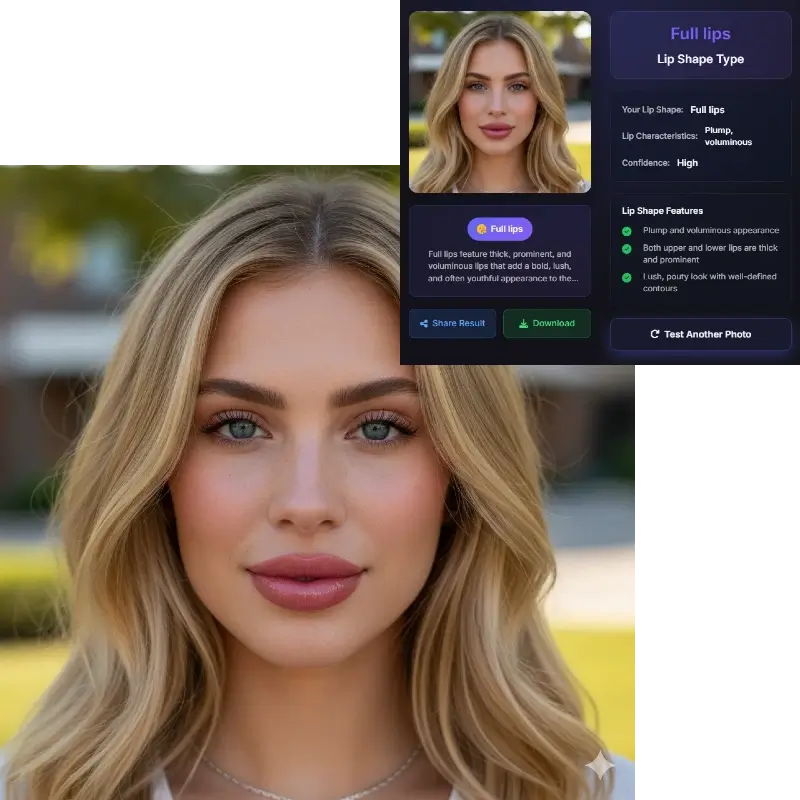
A square face shape often has a broad forehead, wide cheekbones, and a jawline that appears similarly wide. The main clue is stronger angular structure through the lower face. People looking for a square face shape result often want hairstyle or glasses ideas that soften or frame a more defined jaw.
A heart face shape is typically wider in the forehead and cheek area and gradually narrows toward the chin. The lower face can look delicate or tapered, which is why heart face shape results are common among people with a noticeable contrast between upper-face width and a slimmer jawline.
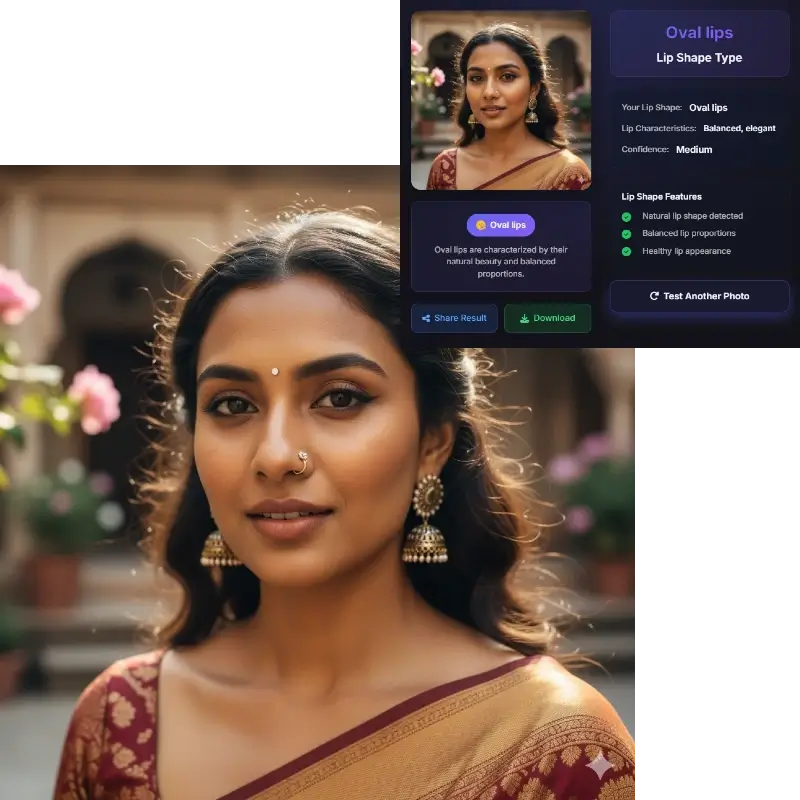
A diamond face shape usually has cheekbones as the widest point, with a narrower forehead and a narrower jaw. It can look sculpted and slightly angular. If your face shape detector result says diamond, the tool is seeing most of the width in the middle of the face rather than at the forehead or jaw.
An oblong face shape, sometimes grouped with rectangle, is noticeably longer than it is wide. The sides of the face can look straighter, and the forehead, cheekbones, and jaw may feel closer in width than in an oval face shape. People with an oblong face often want cuts or frames that add visual width.
A triangle face shape is broader through the jaw than through the forehead. The face appears more grounded at the bottom, which is why some style guides also call it pear-shaped. A triangle result usually means the face shape detector noticed a stronger lower-face width than upper-face width.
A good face shape detector is not only about naming a face shape. It should explain what visible proportions lead to the result. Our face shape detector estimates the closest match by comparing the proportions that matter most in manual face shape guides and face shape calculator methods.
Face length helps separate shapes like oblong and oval from shapes that look more compact. If your face appears clearly longer than it is wide, the detector gives more weight to oval or oblong-style matches.
Forehead width often matters when comparing heart, oval, and triangle face shape patterns. A broader forehead paired with a narrower jaw can point toward heart, while a narrower forehead paired with a broader jaw can point toward triangle.
Cheekbones are often the key difference between oval, diamond, and round face shape results. When the face looks widest at the cheekbones, the detector may lean toward diamond or oval depending on how sharply the face narrows above and below.
Jawline shape helps the tool distinguish between square, round, heart, and triangle face shape results. A broader, more angular jaw pushes the result toward square or triangle, while a softer jaw supports round or oval.
Most people searching for a face shape detector want a fast answer to a simple question: what face shape do I have? This page is built to answer that question directly. Upload a clear portrait, and the tool estimates the closest match based on visible facial balance rather than guesswork. Instead of forcing a label with no explanation, the result is framed as a practical match that helps you understand your outline, not a rigid identity. That matters because face shape is best used as a style reference. The most useful face shape detector should tell you whether your face looks closest to an oval, round, square, heart, diamond, oblong, or triangle pattern and also explain what parts of your face led to that result.

Traditional face shape calculator guides ask you to measure your forehead, cheekbones, jawline, and face length by hand. That method can work, but it is slow and many people are not sure where to measure. Our face shape detector uses the same underlying logic in a more visual way. The AI checks relative width and length, how the face tapers from forehead to chin, and whether the jawline looks soft, angular, narrow, or broad. That means you still get the benefit of a face shape analyzer, but without needing a tape measure. For users comparing this tool to a face shape calculator or face shape test, the difference is convenience: the core idea is still proportion matching, only faster and easier to interpret.

A face shape detector is most useful when the result leads to a real decision. Once you know your closest face shape match, it becomes easier to narrow down hairstyle ideas, glasses frames, contour placement, and overall styling direction. Someone with a round face shape may prefer styles that add vertical definition. Someone with a square face shape may want movement or softness around the jaw. Someone with an oblong face shape might look for cuts or frames that create more width. This is why the page includes style tips after the result. The goal is not to tell you there is one correct look, but to give you a reliable starting point based on the same face shape patterns used in beauty and styling guides.
If your goal is to find your face shape accurately, the photo matters almost as much as the detector. Most incorrect face shape results come from camera angle, hair coverage, expression, or filters that change visible proportions.
A front-facing photo gives the face shape detector the clearest view of your width and length. Extreme angles can make the forehead or jaw look larger or smaller than they are.
Hair covering the forehead, temples, or jawline makes it harder to judge your real face shape. If possible, tuck hair back so the outline is visible.
Balanced lighting helps the detector see your facial outline. Harsh shadows can hide your jawline or change how wide your face appears.
A big smile can change the cheeks and jawline. For the most stable result, use a relaxed expression with your mouth closed.
Beauty filters and wide-angle distortions can change proportions. A natural photo gives the most trustworthy face shape result.
The face shape detector analyzes visible facial landmarks and compares your overall proportions. It looks at face length, forehead width, cheekbone width, jawline width, and how your face tapers from top to bottom. Based on those clues, it returns the closest match among common face shape categories such as oval, round, square, heart, diamond, oblong, and triangle.
That is normal. Different photos can make the same person look slightly more oval, round, or heart-shaped depending on angle, smile, hair placement, and lighting. A face shape detector is comparing what is visible in a single image, so the best approach is to use a clear, front-facing photo and look for the most consistent match across several natural photos.
It serves all three intents. It is a face shape detector because it analyzes a photo, a face shape calculator because it uses visible proportions like length and width, and a face shape test because it gives you an easy result without manual measuring. The underlying idea is the same: identify the closest face shape pattern from your facial proportions.
A face shape detector is most accurate when your face is clearly visible and the image is close to straight-on. Accuracy can drop when hair covers the face, the camera is tilted, a smile changes the cheeks and jawline, or filters distort the image. The result should be treated as a strong style reference rather than a medical or biometric classification.
Yes. Many people use a face shape detector specifically to choose hairstyles, glasses, and contour placement. The result helps narrow down shapes that may balance your proportions. For example, people with a square face shape often explore softer lines, while people with an oblong face shape may look for more width. The goal is to guide styling choices, not limit them.
Not always. Many faces have mixed traits, such as oval with heart-like tapering or square with some round softness. That is why this page shows a primary match, a possible secondary match, and explanation notes. In real life, face shape exists on a spectrum, so the most useful result is the closest match, not a rigid one-word label.