Types of Face Shapes: How to Identify Yours
A practical guide to oval, round, square, oblong, heart, diamond, and triangle face shapes, plus a simple way to compare your own proportions.

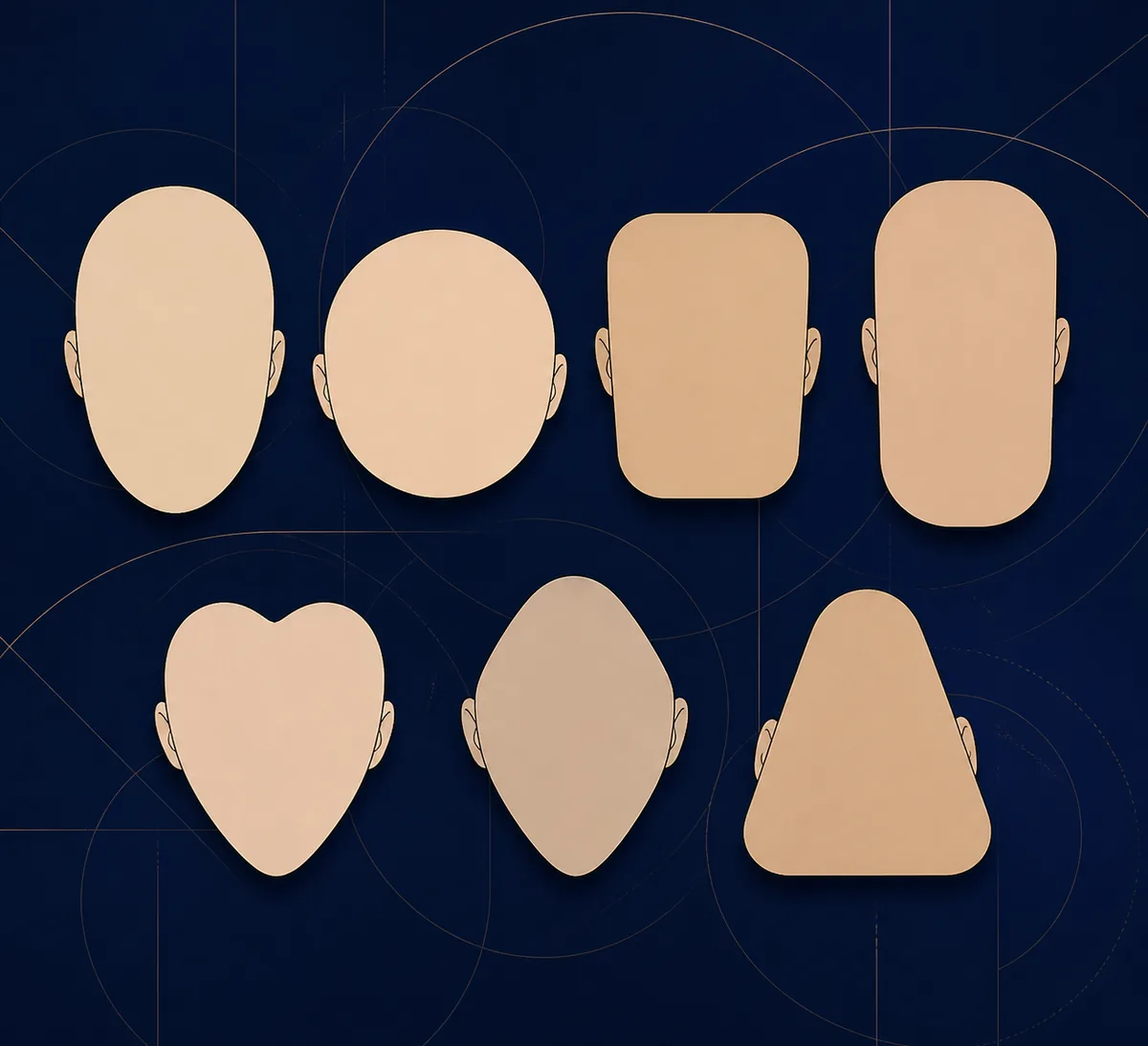
In this guide
What do face shapes describe?
Face shape is a short way to describe the outline and proportions of a face when viewed from the front. The label usually combines several observations: how long the face looks compared with its width, where the widest point sits, how the forehead relates to the cheekbones, and whether the jaw narrows, stays broad, or forms visible angles.
The seven categories in this guide are common style and beauty vocabulary, not medical diagnoses. Real faces often sit between categories. A person can look oval in one photo, oval-oblong in another, or more angular when the hair, expression, camera distance, and lighting change the visible outline.
If you are asking what face shape you have, start with the overall silhouette instead of one feature. A pointed chin does not automatically mean heart-shaped, and a strong jaw does not automatically mean square. The most useful answer is the category that explains several proportions at once.
The main principle
Look at length, width, cheekbones, forehead, jaw, and chin together. A face-shape label is most helpful when it explains the whole outline and still leaves room for natural variation.
How to identify your face shape
You do not need a special measuring tool to make a useful first estimate. Stand in front of a mirror or use a straight-on photo with your hair away from the outline. Imagine a line around the outside of the forehead, cheeks, jaw, and chin, then compare the proportions rather than judging the face from a close-up selfie.
A good comparison asks which feature is most visually dominant. Is the face clearly longer than wide? Is the jaw as wide as the forehead? Are the cheekbones the widest area? Does the lower face taper to a narrow chin, or does it stay broad? These questions are more reliable than matching your face to a single celebrity picture.
- Control the photo: Use a front-facing image taken from a little distance, with the camera near eye level. A very close wide-angle selfie can enlarge the center of the face and distort the outline.
- Compare length and width: Decide whether the face reads as longer than wide, close to equal, or wider than long. This first comparison separates many oblong, oval, round, and square patterns.
- Find the widest area: Notice whether the forehead, cheekbones, or jaw is the broadest part. The location of the width is often more useful than a ruler measurement.
- Look at the jaw and chin together: A softly rounded jaw, a strong horizontal jaw, and a narrow or pointed chin create different outline patterns. Do not judge the chin in isolation.
- Check the full contour: Move your attention from temples to cheeks to jaw. Hair, facial hair, makeup, and a tilted head can hide or exaggerate the true outline.
- Allow a close match: If two categories explain your features equally well, use a blended description such as oval-oblong or heart-diamond instead of forcing a single answer.
If you want a second visual estimate, you can upload a clear photo to the Face Shape Detector.
The main types of face shapes
The categories below are best understood as visual starting points. They describe patterns that commonly appear in styling guides, glasses advice, and face-shape tools. Your face does not need to match every sentence in a category, and the most useful style choices still depend on hair texture, comfort, personal taste, and the look you want.
Use the short check under each type as a comparison prompt. Read across the list before choosing a label, because a broad jaw, high cheekbones, or a narrow chin can appear in more than one face shape.
Oval face shape
An oval face usually looks a little longer than wide, with gently curved sides and a jaw that narrows softly toward the chin. The forehead may be slightly wider than the jaw, but the overall outline feels balanced rather than strongly angular.
Helpful check: Ask whether the face appears balanced first and elongated second. If no single area dominates, oval may be a good starting description.
Round face shape
A round face often has similar visible length and width, fuller cheeks, and a softly curved jaw. The outline may look youthful or smooth, but the label describes proportions rather than age or personality.
Helpful check: Compare the face length with cheekbone width. If the cheeks are the widest area and the jaw has few sharp corners, round may fit.
Square face shape
A square face commonly has a broad forehead, cheekbones, and jaw with a similar horizontal presence. The jaw corners may look defined, creating a stronger angular outline than a round or oval face.
Helpful check: Look for width and jaw structure before focusing on the chin. A broad, relatively straight lower outline is a stronger signal than one sharp corner.
Oblong or rectangle face shape
Oblong and rectangle patterns are visibly longer than wide. Oblong often has softer, more consistent width through the cheeks and jaw, while rectangle suggests straighter sides or stronger jaw angles.
Helpful check: Compare total length with cheekbone width, then look for straight sides and jaw corners. The vertical length should be more noticeable than the lower-face taper.
Heart face shape
A heart-shaped face often has a forehead or upper face that is wider than the jaw, with a noticeable taper toward the chin. The hairline can be rounded or slightly pointed, but the broader upper-to-narrower-lower pattern matters most.
Helpful check: Compare the upper face with the jaw. If the forehead and cheek area carry more width and the chin narrows clearly, heart may be a useful description.
Diamond face shape
A diamond pattern usually has cheekbones as the widest point, with a narrower forehead and a narrower jaw. The outline can look angular or softly tapered depending on the jaw and chin.
Helpful check: Find the widest horizontal point first. If the cheekbones stand out while both the forehead and jaw are narrower, diamond may be closer than heart or oval.
Triangle face shape
A triangle pattern is often wider through the jaw than the forehead, creating a lower-heavy outline. Some people describe a softer version as pear-shaped, especially when the jaw is rounded rather than angular.
Helpful check: Compare jaw width with forehead width. If the lower face carries the most horizontal presence and the forehead is noticeably narrower, triangle may fit.
How to measure face shape with simple proportions
If visual comparison is not enough, use four or five light measurements from a straight-on photo or mirror. The goal is not to produce a scientific identity score. It is to organize what you can already see: face length, forehead width, cheekbone width, jaw width, and the direction of the chin.
A flexible method is more useful than exact numbers. Use the same reference points each time, keep your head level, and record the measurements in the same unit. Then compare the pattern: long relative to wide, widest at the cheeks, widest at the jaw, or fairly even throughout.
Do not pull the skin, press a ruler into the face, or treat a small difference as a hard boundary. Hair, expression, camera perspective, and the way a jawline curves can change a measurement by more than the category difference you are trying to detect.
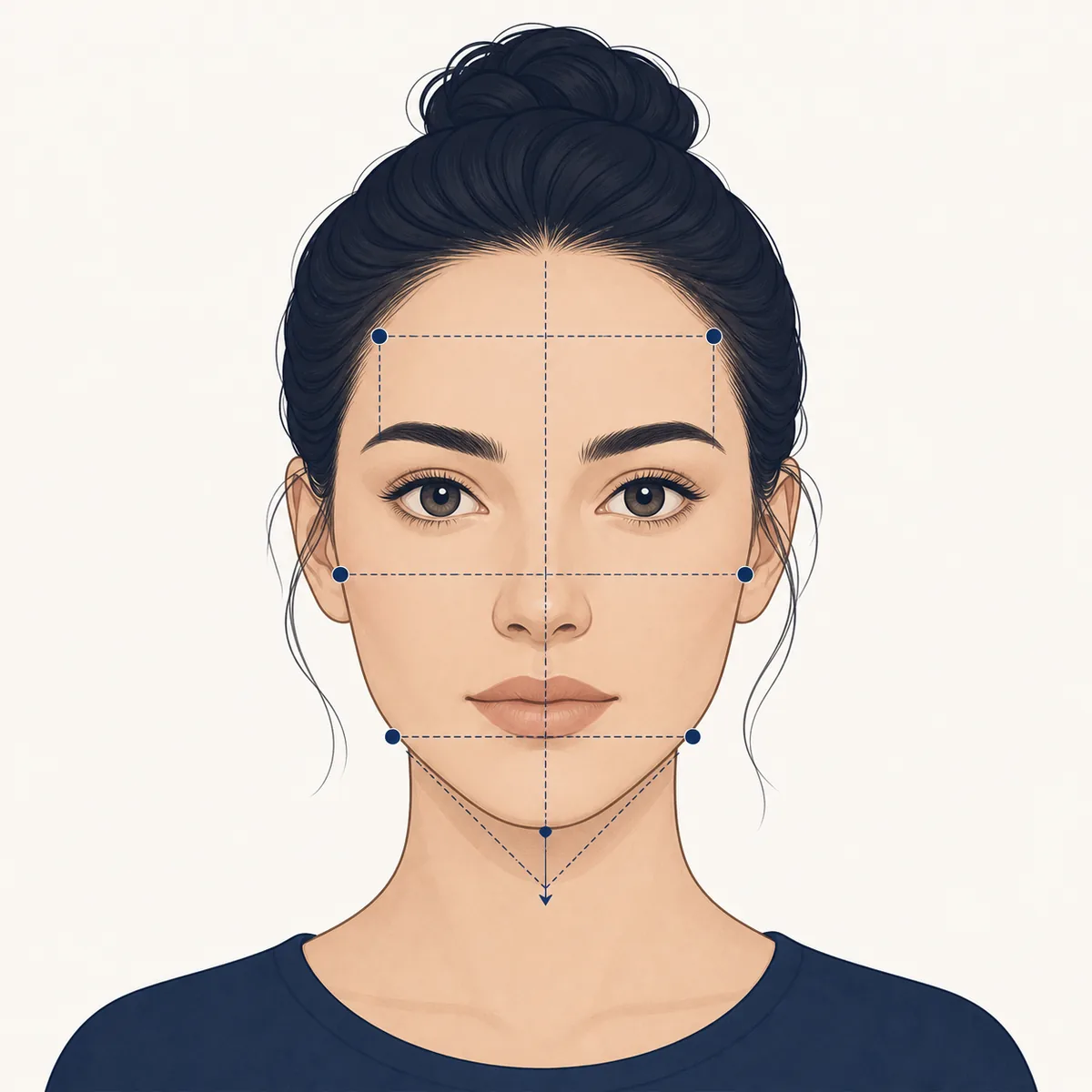
- Measure face length: Estimate from the center of the hairline to the lowest point of the chin. If the hairline is difficult to see, use the visible upper outline consistently and note the limitation.
- Measure the forehead: Compare the widest horizontal part of the forehead, usually across the upper temples. Do not let the hairstyle define the measurement.
- Measure the cheekbones: Use the widest point across the cheekbone area. This helps distinguish diamond patterns from heart, oval, and round patterns.
- Estimate the jaw: Compare the left and right jaw width or observe whether the jaw is rounded, straight, or visibly angular. Consistency matters more than millimetre precision.
- Compare the pattern: Place the observations side by side. The relationship between the widest area, overall length, and lower-face taper is more informative than any single measurement.
| Feature | What to check | Why it matters |
|---|---|---|
| Overall length | Compare hairline-to-chin length with cheekbone width. | Separates longer oblong patterns from rounder or more balanced outlines. |
| Forehead | Find the widest visible part across the upper face. | A wider upper face can support heart or oval patterns. |
| Cheekbones | Find the widest horizontal point across the cheeks. | Prominent cheekbone width is a key clue for diamond and some oval faces. |
| Jaw | Compare width and whether the corners look soft or angular. | A broad or angular jaw supports square or triangle patterns. |
| Chin | Observe whether the lower outline tapers, rounds, or stays broad. | The chin completes the outline but should not be judged by itself. |
How to take a useful face-shape photo
A photo can make a face look longer, wider, or more angular than it appears in person. Wide-angle lenses, close camera distance, a raised phone, a tilted chin, and strong side light all change the visible outline. A controlled photo does not need to be perfect; it only needs to be consistent enough for comparison.
Use the same setup if you compare two photos. A relaxed expression is especially important because a wide smile, pursed lips, or clenched jaw changes the lower face. If your result changes between photos, describe the overlap instead of assuming one image is the absolute truth.
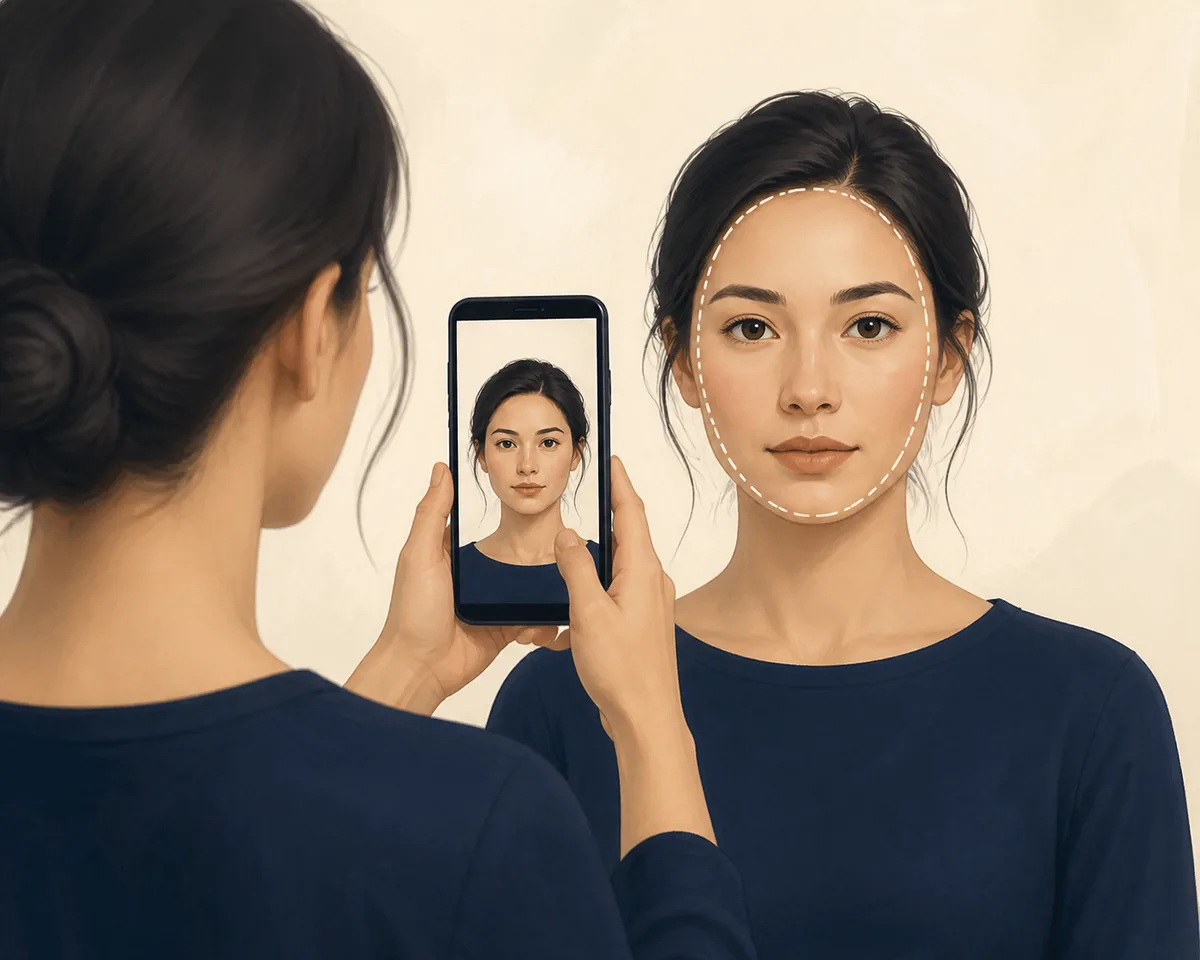
- Keep the camera at eye level: Hold the phone straight and avoid looking up or down. This reduces the chance that the jaw or forehead will appear artificially shortened.
- Step back from the lens: A little distance usually creates a more natural perspective than a close selfie. Use a timer or ask someone else to take the photo if possible.
- Move hair away from the outline: Tuck hair behind the ears or compare a second photo with a different hairstyle. Do not let a haircut become the face-shape label.
- Use soft front light: Even light keeps one cheek or one side of the jaw from disappearing into shadow. Avoid strong side lighting for the first comparison.
- Relax your expression: Keep the mouth relaxed and the jaw unclenched. Facial expression is part of the image, not a permanent change in face shape.
Mixed face shapes and useful limits
Many people do not fit one clean category. Oval-oblong, heart-diamond, round-oval, and square-rectangle are reasonable descriptions when a face shares meaningful features from both groups. A blended label is often more honest than choosing a category because one feature happens to stand out in a single photo.
Face shape also changes visually with age, weight fluctuation, facial hair, makeup, glasses, hairstyle, expression, and camera angle. That does not make the category useless; it simply means the category is a styling vocabulary, not a permanent measurement of worth or identity.
Use the label to choose questions, not rules. If you are choosing glasses, compare frame width and comfort. If you are choosing a haircut, consider texture and maintenance. If an AI face shape tool gives a different result from your own observation, treat both as estimates and inspect the photo conditions before deciding which description is more useful.
A practical way to use the result
Choose the label that explains the largest number of visible proportions, keep a blended description when needed, and use styling advice as options rather than instructions.
Types of face shapes FAQ
Related face-shape resources
Last updated: August 11, 2026
Try the Face Shape Detector